
Testosterone replacement therapy is surrounded by myths, and most of them trace back to one source of confusion: the abuse of high-dose anabolic steroids gets attributed to medical TRT, even though they are very different things. Properly dosed, physician-monitored TRT restores testosterone to a healthy normal range, which is not the same as using doses many times higher for performance. Below, we separate what is genuinely true from what is myth, with the science behind each. At True Roots in La Canada Flintridge, TRT is physician-led and monitored by board-certified Dr. Luis Valle.
Myth: TRT causes aggression and "roid rage"
This is a myth. Properly dosed TRT does not cause aggression or roid rage, and that stereotype comes from high-dose anabolic steroid abuse, not from testosterone restored to a healthy range. In fact, the reverse is often true: low testosterone itself can cause irritability and low mood, and many men report a steadier, improved mood once their levels are restored. The "rage" image is about misuse of supraphysiologic doses, not medical treatment.
Myth: TRT is just for bodybuilders
Also a myth. TRT is a medical treatment for men with diagnosed low testosterone and real symptoms, prescribed to restore a healthy normal range and relieve issues like fatigue, low libido, and low mood. It is fundamentally different in purpose and dose from the high-dose steroid use associated with bodybuilding. The men on legitimate TRT are typically those addressing a genuine deficiency, not chasing performance. See what TRT is.
Partly true: TRT can shrink your testicles
This one has truth to it, which is why honesty matters. Because external testosterone reduces the brain signals that drive the testes' own production, TRT can cause some testicular shrinkage and reduced sperm production. The important context: it is often manageable, and medications like hCG can help maintain testicular size and function. If this concerns you, or if fertility matters, it is a specific thing to plan for with your physician rather than a reason to dismiss TRT entirely.
Partly true: TRT can speed up hair loss
Also honest nuance rather than a clean myth. TRT does not create male pattern baldness in a man who was never going to lose his hair, but more available testosterone means more conversion to DHT, and in a genetically sensitive follicle that can move the timeline forward. The answer is to know your risk before you start rather than after. See does TRT cause hair loss for the mechanism and the options.
Myth (mostly): TRT causes prostate cancer
Largely a myth in the simple cause-and-effect form. Current evidence does not show that properly monitored TRT causes prostate cancer, a fear rooted in older theory that has not held up. The real, manageable nuance is that testosterone can stimulate an existing prostate cancer, which is exactly why PSA screening and prostate assessment are part of responsible care, and why TRT is avoided in active untreated prostate cancer. The answer is screening and monitoring, not avoidance.
Myth (increasingly): TRT causes heart attacks
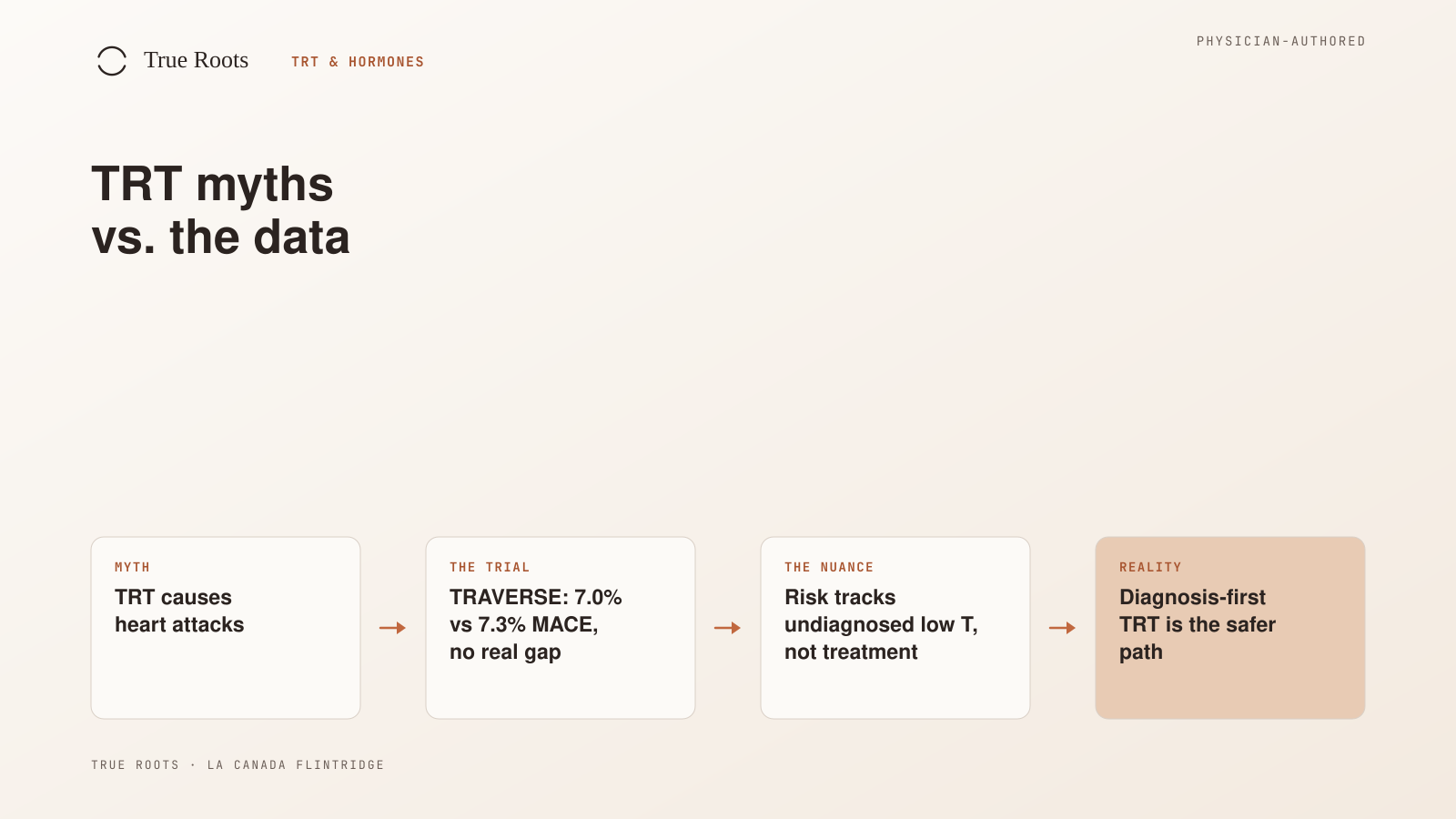
The cardiovascular picture has improved, not worsened. The FDA's own class-wide labeling review (Feb 2025) removed the cardiovascular boxed-warning language from testosterone products after the TRAVERSE trial, a 5,204-man study with a mean 33-month follow-up, found major adverse cardiac events in 7.0% of testosterone users versus 7.3% on placebo: no increased risk. One real, monitorable effect is that TRT can raise red blood cell count and blood pressure, which is checked regularly and managed if it climbs too high. A good physician weighs your cardiovascular risk factors first and monitors throughout. As with the prostate, the theme is careful selection and monitoring. See is TRT safe for the full detail.
New nuance: the risk that matters is skipping the diagnosis, not the treatment itself
A 2026 study in eBioMedicine, following roughly 359,000 men for up to 10 years, found something worth sitting with: men who used testosterone without a documented low-testosterone diagnosis had about 50% higher risk of a serious cardiovascular event and nearly double the all-cause mortality risk compared with men who used it with a confirmed diagnosis. The authors are careful to note this is observational data, not proof that skipping a diagnosis directly causes those outcomes.
This does not overturn the myths above. It sharpens them. The dividing line was never "TRT versus no TRT," it is diagnosed, monitored TRT versus testosterone use with no confirmed deficiency and no physician tracking the numbers. That is exactly why testing before treating is not a formality here, it is the thing that separates a safe protocol from a risky one.
The big one: "TRT is a steroid"
This is where most myths originate, so it deserves a clear answer. Testosterone is technically an anabolic steroid hormone, but properly dosed TRT is very different from anabolic steroid abuse. TRT restores testosterone to a normal physiologic range under medical supervision; steroid abuse uses doses many times higher for performance, without monitoring. Calling TRT "a steroid" conflates a medical treatment with misuse of the same molecule, and it is the root of nearly every other myth on this list. For the full breakdown, see TRT vs. steroids.
Why the myths persist
These myths persist because the dramatic stories, aggression, health scares, come from unsupervised high-dose misuse, which makes for memorable headlines, while quiet, well-monitored medical TRT does not. The practical takeaway is simple: the safety and effects of testosterone depend enormously on the dose and the oversight. Physician-led TRT at a healthy range is a different thing from steroid abuse, and judging one by the other is the core mistake.
This article is educational and not a substitute for personalized medical advice.