
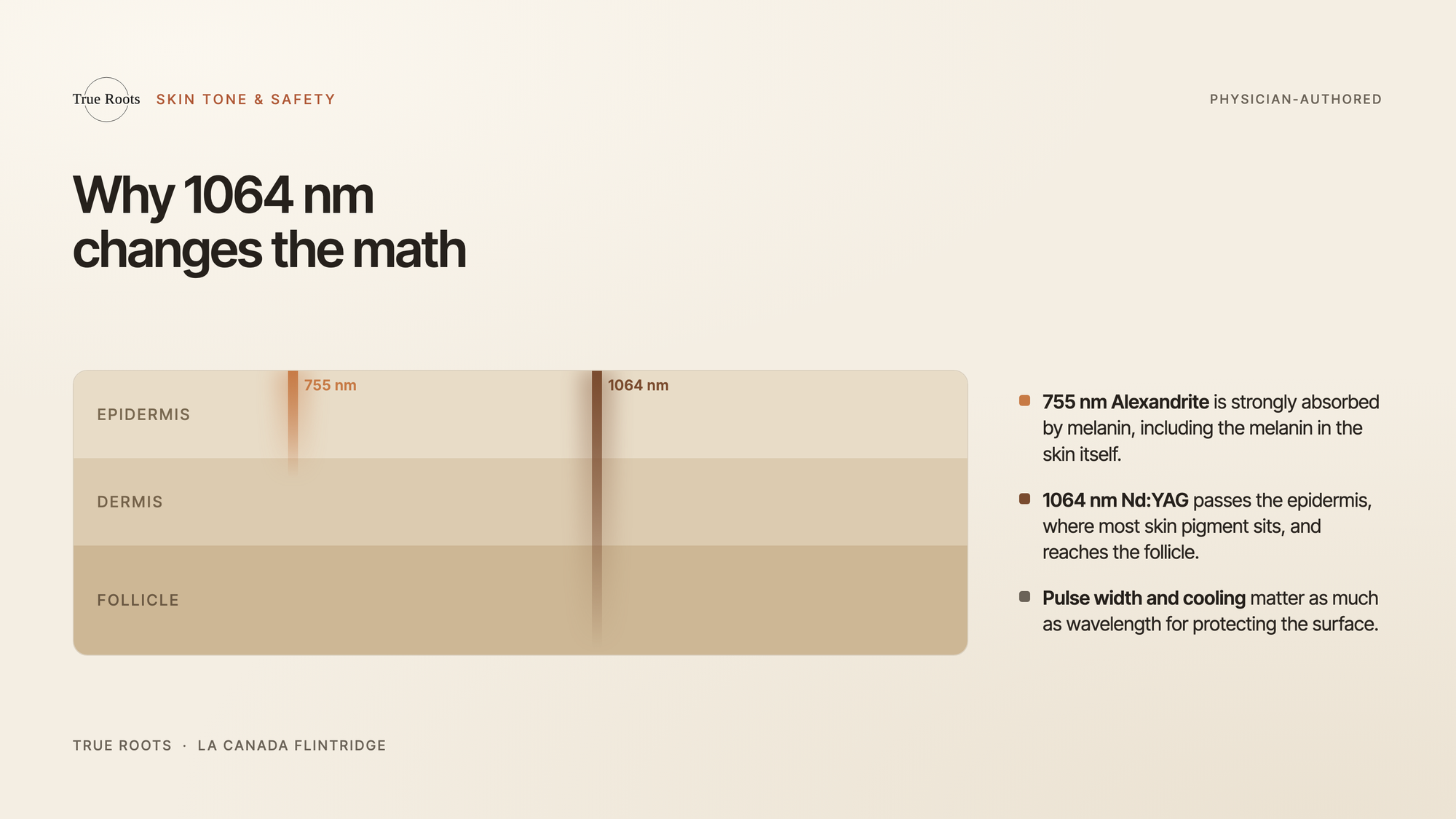
Laser hair removal is safe and effective on dark skin when the provider uses the right wavelength. The 1064 nm Nd:YAG wavelength penetrates past the epidermis, where most skin pigment sits, and releases its energy at follicle depth. That single choice, plus pulse width, cooling, and conservative settings, is what separates a clean result from a burn.
Why was laser hair removal historically risky on darker skin?
Laser hair removal works by selective photothermolysis. Energy is absorbed by melanin in the hair shaft and follicle, converted to heat, and that heat disables the follicle's ability to produce hair.
The catch is that melanin is also what gives skin its color. On fair skin there is little competing pigment, so nearly all the energy lands where it should. On Fitzpatrick IV to VI, the epidermis holds a great deal of melanin, and older devices could not reliably tell hair pigment from skin pigment.
That is the source of every bad story you have heard. Ruby lasers, and alexandrite run at aggressive settings, deposited too much energy in the epidermis, producing burns, blistering, hypopigmentation (light patches) and hyperpigmentation (dark patches). The technology was the problem, not the patients.
What is the Fitzpatrick scale, in plain language?
It classifies skin by how it responds to sun, not by ethnicity, so a provider can choose settings instead of guessing. Much of Glendale, Pasadena, and greater Los Angeles sits in the III to V range.
| Fitzpatrick type | Typical appearance | Preferred wavelength approach | Key precaution |
|---|---|---|---|
| I to II | Very fair to fair, burns easily, rarely tans | 755 nm alexandrite, highly efficient on light skin | Standard cooling, watch for fine or light hair that lacks pigment |
| III | Light olive, sometimes burns, tans gradually | Alexandrite, or a blend with Nd:YAG if recently sun exposed | Reassess after summer sun and any tanning |
| IV | Olive to light brown, rarely burns, tans easily | Blended emission, weighting Nd:YAG upward | Longer pulse width, robust cooling, avoid tanning before sessions |
| V | Brown, very rarely burns, tans readily | Predominantly 1064 nm Nd:YAG | Conservative fluence, test patch, post-inflammatory hyperpigmentation risk |
| VI | Deeply pigmented, does not burn | 1064 nm Nd:YAG | Lowest melanin competition tolerance, test patch is essential |
Why does 1064 nm Nd:YAG change the math?
Longer wavelengths are absorbed less avidly by melanin and travel deeper into tissue. Nd:YAG at 1064 nm passes through the pigment-dense epidermis with comparatively little absorption and delivers its energy at the depth where the follicle lives.
That is why it is widely considered the safe wavelength across Fitzpatrick IV to VI. Nd:YAG does not ignore pigment, it still needs melanin in the hair to work. The ratio simply shifts in the patient's favor.
The tradeoff is honest: Nd:YAG is somewhat less efficient per pass on fine hair than alexandrite. That is a reason to expect a full course of sessions, not a reason to accept the wrong wavelength.
Do pulse width and cooling matter as much as wavelength?
Close to it. Wavelength decides where the energy goes. Pulse width and cooling decide how much heat the skin surface has to survive on the way.
A longer pulse width spreads the same energy over more time, which lets the epidermis shed heat while the thicker follicle still reaches the temperature needed to be disabled. Active cooling, whether contact cooling on the handpiece or chilled air at the skin, pulls heat off the surface before and after the pulse. Published protocols exist for dialing fluence, pulse duration, and cooling by Fitzpatrick type, which is exactly what a trained operator is doing while you are on the table. The Splendor X we run uses Cryo-Touch contact cooling and Cryo-Air. More on the hardware in the Splendor X technology guide.
Why is an adjustable dual-wavelength blend better than one setting for everyone?
Most systems make you pick a lane: an alexandrite device or an Nd:YAG device, one wavelength, one compromise.
The Lumenis Splendor X emits both 755 nm alexandrite and 1064 nm Nd:YAG, and its BLEND X mode emits them simultaneously in adjustable proportions. Per Lumenis, it is the only FDA-cleared system with adjustable synchronized dual-wavelength Alex plus Nd:YAG emission. Practically, the ratio can be weighted toward Nd:YAG for a Fitzpatrick V patient and shifted for a Fitzpatrick III patient with fine hair, on the same device, in the same room. For how that compares with other hardware categories, see laser vs IPL vs diode.
What should a proper consultation and test patch look like?
Your provider should type your skin, ask about recent sun exposure, tanning beds, and self-tanner, review medications that increase photosensitivity, and ask what has been done to the area before (waxing and plucking remove the target).
Then they should test. A test patch means treating a small area at the intended settings and checking it after a set interval, before committing to a full session. A clinic that will not do this on Fitzpatrick IV to VI skin has told you what you need to know.
What does the published research say about preventing dark spots?
This is not guesswork. A February 2025 systematic review in the Australasian Journal of Dermatology, covering 14 studies and 369 cases, confirmed that post-inflammatory hyperpigmentation after energy-based treatments affects all skin tones but shows a heightened predilection for Fitzpatrick III to VI, and catalogued the protocols that measurably lower the risk: diligent sunscreen before and after treatment, short courses of topical corticosteroids when indicated, and conservative energy settings. A 2026 network meta-analysis in Lasers in Surgery and Medicine extended that evidence base specifically to laser and energy-device-induced hyperpigmentation. The takeaway is not "darker skin is riskier and nothing can be done." It is that a specific, evidence-backed protocol exists, and a provider who follows it is working from real data rather than instinct.
What are the honest caveats?
Results vary. This is permanent hair reduction, not permanent removal, and maintenance sessions are common.
Laser only affects hair in the anagen (growth) phase, which is why treatment is a course rather than an appointment. One published series in skin of color reported a mean of about 8.9 treatments, with a range of 4 to 22. It also needs pigment in the hair, so white, grey, and very light blonde hair do not respond to any laser, regardless of skin tone.
Sun exposure genuinely matters. A fresh tan raises epidermal melanin and changes the safety calculation, which is why sessions get postponed rather than pushed through. And the risk of post-inflammatory hyperpigmentation is never zero on darker skin. It is managed through settings, cooling, sun avoidance, and aftercare. See what to expect from treatment for the full picture.
The one question to ask any clinic
What wavelength will you use on me, and why.
A provider who can answer that in a sentence, name the device, and offer you a test patch is worth your time. A provider who says the machine handles it is not.
True Roots Performance & Aesthetics is in La Canada Flintridge, serving Glendale, Pasadena, and the greater Los Angeles area. Laser hair removal here is performed on the Lumenis Splendor X by a licensed nurse practitioner who is physician-trained and Lumenis-certified, with settings selected for your Fitzpatrick type rather than a single house preset. See current laser pricing on our pricing page, and start with how laser hair removal works if this is new to you.
This article is educational and not a substitute for personalized medical advice.