
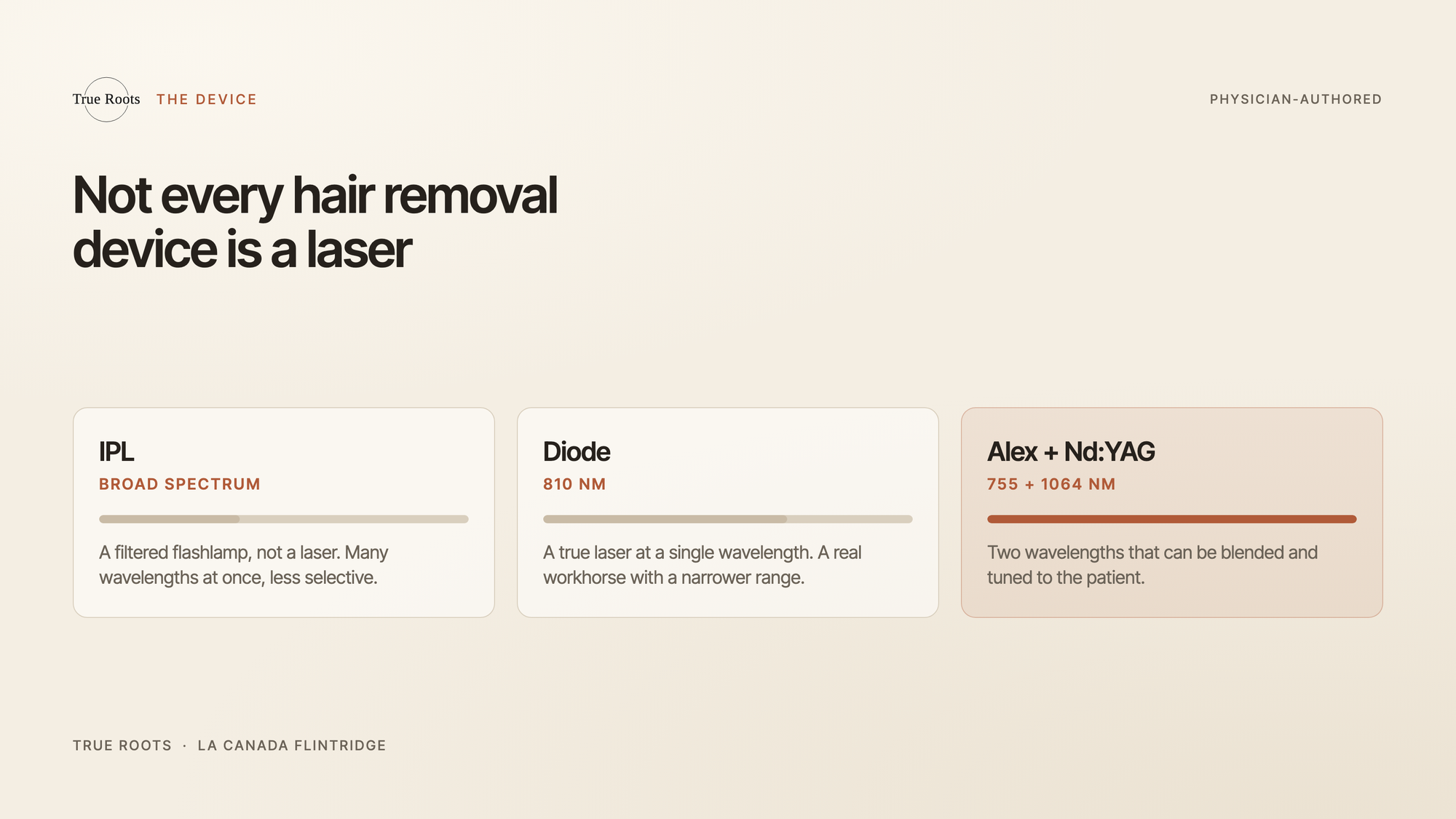
IPL is not a laser. It is a broad-spectrum flashlamp that emits many wavelengths at once, filtered rather than focused, so its energy is less selectively delivered to the hair. Diode, Alexandrite, and Nd:YAG lasers each emit one precise wavelength. That precision is why true lasers generally need fewer sessions and handle a wider range of skin tones.
Almost nobody shopping for hair removal is told which category a clinic actually uses. It is the single most useful question to ask, because it sets the outer limit on what your result can be.
Is IPL a laser?
No, and the difference is not marketing hairsplitting.
IPL stands for intense pulsed light. The device uses a flashlamp that emits a broad band of wavelengths, roughly 500 to 1200 nm depending on the system, then applies cutoff filters to remove the parts that are least useful for the target.
A laser does something different. It emits coherent light at one wavelength, chosen deliberately for how melanin absorbs it. Every photon is doing the same job.
The consequence is selectivity. With IPL, some of the emitted energy lands on the follicle usefully and some is absorbed by other structures or scattered. You get a less concentrated dose on target for the same amount of light going into the skin.
In practice that means IPL typically needs more sessions to reach a comparable result, and it demands more caution as skin tone deepens, since the shorter wavelengths in the band are readily absorbed by epidermal melanin.
None of that makes IPL useless. On light skin with dark, coarse hair, IPL can produce genuinely good reduction, and it is often the more accessible option for large areas. It is a real tool with a narrower window.
Where does a diode laser fit?
Diode is a true laser, most commonly at 810 nm, and it earned its popularity honestly.
At 810 nm it strikes a workable middle: absorbed by melanin well enough to be effective, long enough to penetrate to the depth of most terminal hair, and long enough to be reasonably safe on a fairly wide range of skin tones with appropriate settings.
Many diode platforms also use a moving, in-motion technique with rapid low-energy pulses, which is comfortable and fast on large areas like legs and backs.
If a clinic tells you they use a well-maintained diode and the operator knows what they are doing, that is a legitimate answer. The limitation is simply that it is one wavelength, so it approximates rather than optimizes at either end of the spectrum.
Alexandrite vs Nd:YAG: the actual tradeoff
These two are the poles of the whole category, and understanding them explains everything else.
755 nm Alexandrite is absorbed strongly by melanin. That is an advantage when the hair does not have much pigment to work with, so it performs well on fine and lighter hair. The same strong absorption becomes a liability on deeply pigmented skin, because the epidermis competes for the light.
1064 nm Nd:YAG penetrates deeper and is absorbed far less by epidermal melanin. It passes the pigment layer that makes shorter wavelengths risky, which is why it became the standard for darker skin and for coarse, deep hair. The price is lower overall absorption, so more energy is needed for the same effect.
There is no wavelength that wins both ends. That is the tradeoff single-wavelength devices are stuck with. See laser hair removal on dark skin for how this plays out clinically.
Why does blending two wavelengths help?
Because the tradeoff above is a dial, not a binary, and most patients sit somewhere in the middle of it.
A dual-wavelength system that fires 755 nm and 1064 nm together in an adjustable proportion lets the operator choose a mix instead of a side. Fair skin with fine hair leans one way, deeper skin with coarse hair leans the other, and everything in between gets a setting rather than the closest available compromise.
That flexibility is the argument for blended emission, and it is worth understanding in detail: inside Splendor X covers how simultaneous adjustable blending works, along with spot geometry and power.
The comparison in one table
| Technology | Wavelength | Precision | Best for | Skin tone range | Typical course |
|---|---|---|---|---|---|
| IPL | Broad spectrum, roughly 500-1200 nm, filtered | Low. Many wavelengths, dispersed delivery | Light skin with dark hair, large areas, budget access | Best on lighter tones. More caution as tone deepens | Commonly more sessions than a laser |
| Diode | Usually 810 nm | High. Single wavelength | Coarse hair, large areas, an effective all-rounder | Fairly wide with appropriate settings | Comparable to other lasers |
| Alexandrite | 755 nm | High. Strongest melanin absorption | Fine and lighter hair on lighter skin | Narrower. Requires caution on deeply pigmented skin | Often efficient when well matched |
| Nd:YAG | 1064 nm | High. Deepest penetration | Coarse and deep hair, darker skin | Widest, including deeply pigmented skin | Sometimes more, since absorption is lower |
| Dual-wavelength blend | 755 nm and 1064 nm together, adjustable | High and tunable per patient | Mixed hair and skin combinations | Broad, tuned to skin tone | Set by the plan, not the machine alone |
| Home devices | Usually IPL, sometimes low-power diode | Low, by regulatory design | Maintenance and touch-ups | Narrow, per manufacturer instructions | Ongoing and indefinite |
Session counts here are general patterns, not promises. One published series in skin of color reported a mean of about 8.9 treatments with a range of 4 to 22, which shows how wide individual variation runs regardless of platform.
The variable that never makes the spec sheet
The device sets the ceiling. The operator determines whether you get anywhere near it.
Fluence, pulse duration, spot size, cooling, and blend ratio all have to be selected for your specific skin type and hair, then adjusted across the course as hair thins and responses change. Settings that are too conservative produce disappointing results on excellent hardware. Settings that are too aggressive produce problems on the same hardware.
A patch test, a documented Fitzpatrick assessment, and a provider who explains what they are changing and why are better signals than a brand name on the machine. How to choose a clinic covers what to look for.
What about at-home devices?
They work a little, and their limits are structural rather than a failure of engineering.
Consumer devices are sold for unsupervised use, which means regulators require them to operate at energy levels far below professional systems. Lower energy means less heat reaching the follicle, which means slower and less complete reduction, and the need to keep repeating indefinitely.
Used honestly as a maintenance tool between or after professional sessions, they have a place. Used as a substitute for a clinical course, most people find the result underwhelming and stop. The biology behind why energy matters is covered in how laser hair removal actually works.
Where this leaves you
Ask the clinic three questions: which device, which wavelength or wavelengths, and who is operating it. Any provider confident in their setup will answer all three without hedging.
True Roots Performance & Aesthetics is in La Canada Flintridge, serving Pasadena, Glendale, and greater Los Angeles. Treatments are performed on the Lumenis Splendor X, a dual-wavelength 755 nm and 1064 nm system, by a licensed nurse practitioner who is physician-trained and Lumenis-certified.
This article is educational and not a substitute for personalized medical advice.