
Splendor X is a dual-wavelength laser hair removal system from Lumenis. It fires 755 nm Alexandrite and 1064 nm Nd:YAG at the same time, in a proportion the operator sets, through a square spot up to 27 by 27 mm, at up to 250 W. That combination is what makes treatment fast, comfortable, and adjustable across skin tones.
Most clinics never explain their machine. That is a shame, because in laser hair removal the hardware genuinely determines what is possible. Here is what is actually inside this one.
What do 755 nm and 1064 nm each do best?
Every hair removal laser lives on one tradeoff: melanin absorption versus depth of penetration. Shorter wavelengths are absorbed more strongly. Longer wavelengths travel deeper and are absorbed less indiscriminately.
755 nm (Alexandrite). This wavelength is strongly absorbed by melanin, which makes it efficient on fine and lighter hair that does not carry much pigment to begin with. Less energy is wasted, so hairs that would be borderline on a longer wavelength become treatable. The catch is that it does not distinguish between melanin in the hair and melanin in the skin, so on deeper skin tones it demands caution.
1064 nm (Nd:YAG). This wavelength penetrates deeper and is absorbed less by epidermal melanin, which is exactly why it became the standard for darker skin. It passes the pigment layer that makes shorter wavelengths risky and reaches follicles sitting deeper in the dermis, which matters on coarse body hair. The tradeoff is lower absorption overall, so it needs more energy to do the same work.
Pick one and you are choosing which patients you serve well. That is the compromise every single-wavelength device makes.
What is BLEND X, and why blend instead of choosing?
BLEND X is the Splendor X mode that fires both wavelengths simultaneously and synchronously, in a ratio the operator sets. Lumenis states it is the only FDA-cleared simultaneous dual-wavelength Alexandrite plus Nd:YAG emission that can be adjusted and synchronized.
The distinction between simultaneous and sequential is the interesting part. Plenty of platforms carry both wavelengths and switch between them, one pass at a time. Firing them together means a single pulse can carry both the absorption advantage of 755 nm and the depth and skin-tone safety of 1064 nm.
Because the proportion is adjustable, the blend becomes a dial rather than a switch. Fair skin with fine hair sits toward one end. Deeper skin with coarse hair sits toward the other. Everyone in between gets a mix, rather than the nearest available approximation.
That is the practical argument: the device gets tuned to the patient instead of the patient being sorted into whichever wavelength the clinic happens to own. More on that in laser hair removal on dark skin.
Why does a square spot beat a round one?
This one is pure geometry. Circles cannot tile a plane. Squares can.
Lay round spots side by side and you get one of two outcomes. Butt them against each other and untreated slivers remain in the gaps between circles. Overlap them to close those gaps and you deliver energy twice to the overlapping skin, which is both wasteful and less comfortable.
The Splendor X uses a patented square fiber spot in sizes up to 27 by 27 mm. Square tiles edge to edge. Each pulse sits next to the last with no missed area and no double dose, which is why coverage becomes both more even and more efficient. Lumenis states the square geometry delivers roughly 37 percent larger effective coverage than leading competitors.
Even coverage is not a cosmetic detail. Patchy results are usually a coverage problem, not a power problem.
What does 250 watts actually buy?
Output power is not a bragging number on its own. It matters because of what it lets three other variables do at the same time.
Fluence is the energy delivered per unit of skin. Spot size is how much skin each pulse covers. Repetition rate is how fast pulses can fire. On an underpowered system, pushing any one of those forces you to give up the others: big spot at low energy, or high energy at a slow rate.
At up to 250 W, Splendor X can hold high fluence across a large square spot at a high repetition rate. That is the engineering reason a full back is a short appointment rather than a long one, and it is also why the operator does not have to trade therapeutic energy away just to finish in a reasonable time.
Speed is nice. Not having to choose between speed and effective settings is the real benefit.
How does the cooling work?
Every laser pulse deposits heat, and some of it reaches the epidermis. Cooling is what keeps that from becoming a comfort or safety problem.
Splendor X uses Cryo-Touch and Cryo-Air. Cryo-Air delivers cold air precisely over the treatment area, drawing heat out of the tissue during and around each pulse, while contact cooling protects the skin surface directly.
Practically, that means the epidermis is protected while the follicle still receives full energy, and most patients describe the sensation as a warm snap rather than something they need to brace for. Comfort is not a luxury feature here. A patient who can tolerate the session is a patient who finishes the course.
Is this the newest version of the device?
Lumenis released an enhanced Splendor X system in April 2025, still built on the same BLEND X foundation described above, with updated digital controls. Lumenis presented data from a prospective, multi-center, 12-month clinical trial on the enhanced system at the 2025 American Society for Laser Medicine and Surgery conference. The wavelength physics and square-spot geometry that make Splendor X work have not changed. What has improved is the control layer operators use to apply them.
The specs in one place
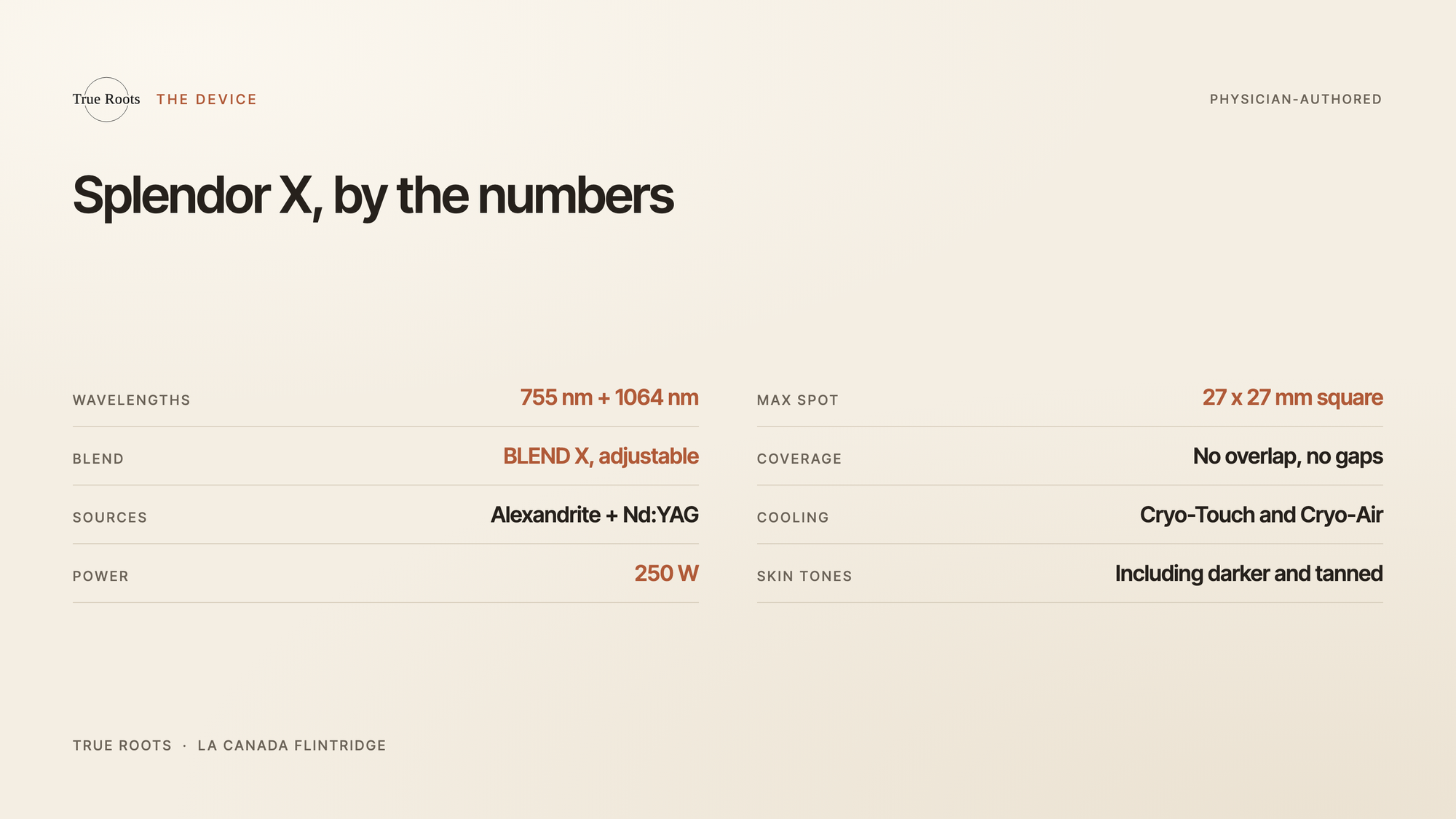
| Spec | Splendor X |
|---|---|
| Wavelengths | 755 nm Alexandrite and 1064 nm Nd:YAG |
| Emission mode | BLEND X: simultaneous, synchronized, adjustable ratio |
| Max spot size | Square, up to 27 by 27 mm |
| Output power | Up to 250 W |
| Cooling | Cryo-Touch contact cooling and Cryo-Air chilled air |
| Skin tones | Suitable across skin tones, including darker and tanned skin |
| Coverage claim | Roughly 37 percent larger than leading competitors (per Lumenis) |
| Other cleared uses | Wrinkle reduction, vascular lesions, pigmented lesions |
Figures describing the device come from Lumenis. Individual results always depend on hair, skin, and the plan.
What does all of this mean in the chair?
Hardware only counts if it changes the appointment. This does, in four ways.
Sessions run shorter, because power plus a large square spot plus a high repetition rate covers ground quickly. Coverage is more even, because the square tiles instead of overlapping. Comfort is better, because cooling runs continuously. And the settings can be matched to you rather than to the machine's one comfortable operating point.
The other half of the equation is the person running it. Fluence, pulse width, and blend ratio still have to be chosen and adjusted, which is why the device and the operator both decide your result. Coarse, dense body hair in particular rewards a device that can hold high energy across a big spot, covered in laser hair removal for men.
True Roots Performance & Aesthetics is in La Canada Flintridge, serving Pasadena, Glendale, and greater Los Angeles. Every laser hair removal session here is performed on the Lumenis Splendor X by a licensed nurse practitioner who is physician-trained and Lumenis-certified. If you want the biology behind the beam, start with how laser hair removal actually works.
This article is educational and not a substitute for personalized medical advice.