
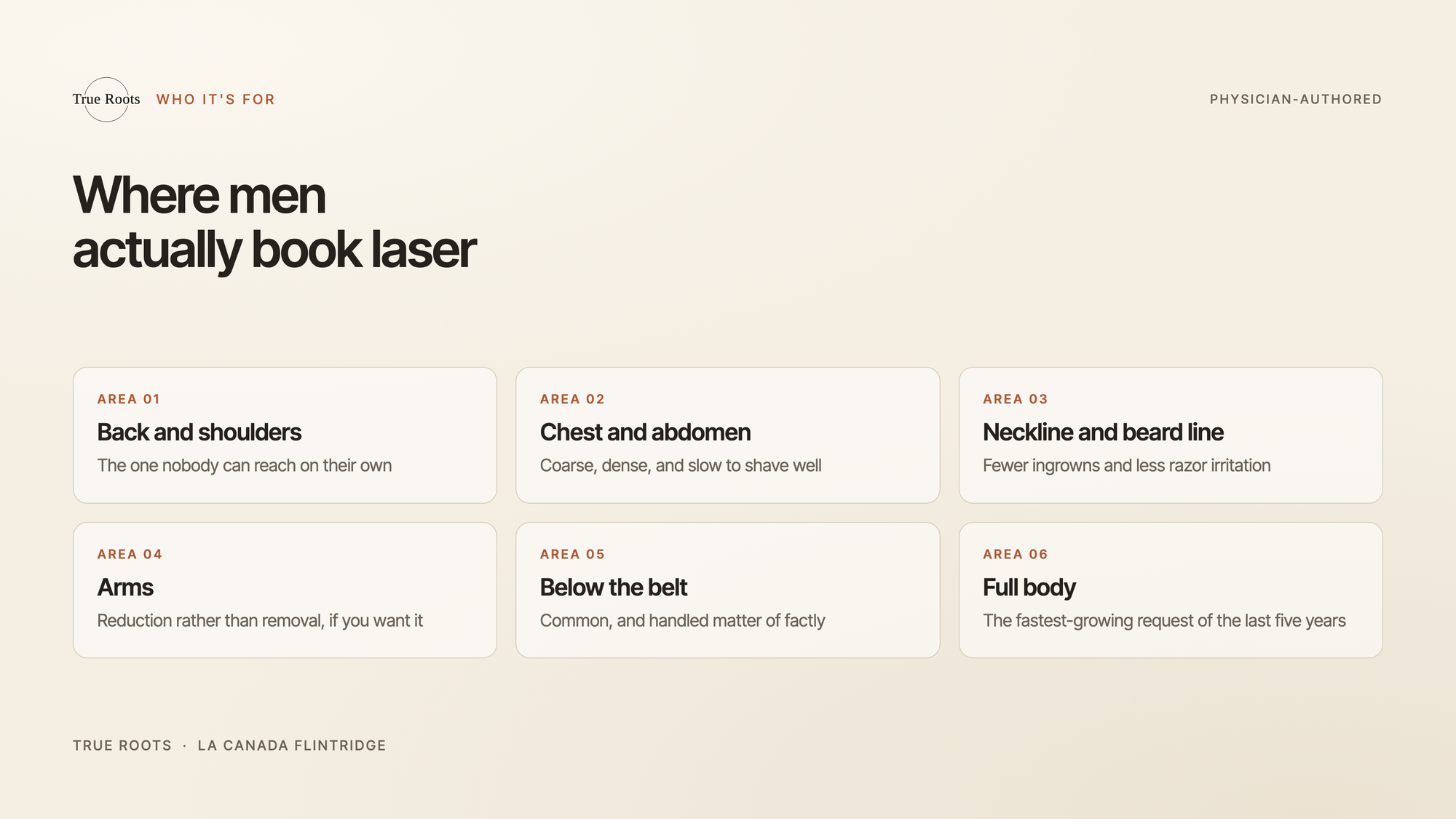
Laser hair removal works well on men because male body hair is exactly what the technology targets: coarse, dark, densely pigmented. The most-booked areas are the back, shoulders, chest, abdomen, neckline, and below the belt. Expect a course of sessions rather than one visit, and expect periodic maintenance on hormonally driven areas.
Why are more men booking laser hair removal?
Because the practical math is good. Shaving your chest twice a week for twenty years is a lot of hours, and nobody enjoys asking someone to do their back.
Frame it as grooming, because that is what it is. The same reason you keep your beard line clean and your workout consistent.
Which areas do men actually book?
Back and shoulders. The most common request, and the one with the clearest quality-of-life payoff. You cannot reach it, waxing means an appointment every few weeks, and the regrowth stage is worse than the hair.
Chest and abdomen. Men usually want reduction rather than elimination here. Less bulk, less shaving, and definition that reads better on a lean physique instead of being hidden under coverage.
Neckline and beard line. Shaping rather than removal. A clean neckline that stays clean, plus fewer ingrown hairs and razor bumps in the area that gets irritated most.
Below the belt. Routine, common, and handled without any coyness. Less friction under gear, less irritation in the heat, and less maintenance. The treatment protocol is the same as anywhere else.
Ears, nose bridge, between the brows, hands and feet. Small areas, quick sessions, and the ones men are usually most relieved to stop dealing with.
What is different about treating men?
Male hair is coarser and denser, and much of it is androgen-driven. That cuts both ways.
Coarse, dark hair absorbs laser energy efficiently, which is a genuine advantage. The technology relies on melanin in the hair absorbing energy and converting it to heat, so a thick pigmented shaft is a better target than a fine one.
Density is the other side. A male back carries far more follicles per square inch than a woman's underarm, and only the hairs currently in the anagen (growth) phase respond to a given session. More hair means more cycles to catch, so plan on more sessions on the back and chest than a smaller area would need.
Hormones keep working after treatment. Testosterone can recruit new terminal hairs over the years, particularly on the chest, shoulders, and back. That is why this is permanent hair reduction, not permanent removal, and why periodic maintenance is normal rather than a sign something failed.
| Area | Hair character | Session expectation | Notes |
|---|---|---|---|
| Back and shoulders | Coarse, dense, wide surface | Full course, higher end | Biggest convenience payoff, cannot self-maintain |
| Chest and abdomen | Coarse, variable density | Full course | Most men choose reduction over full clearance |
| Neckline and beard line | Very coarse, curly | Course plus shaping touch-ups | Often booked for ingrown hairs, not removal |
| Below the belt | Coarse, androgen-driven | Full course plus maintenance | Comfort managed with active cooling |
| Ears, nose bridge, brow gap | Sparse, coarse | Short sessions | Quick add-on to a larger area |
How long does a large area actually take?
Less time than the internet suggests, on the right hardware. Coverage speed is a function of spot size, power, and repetition rate.
The Lumenis Splendor X uses a patented square fiber spot up to 27x27 mm, which tiles edge to edge with no overlap and no missed gaps. Lumenis states this delivers roughly 37% more coverage than leading competitors. It runs at 250 W, which supports high fluence at large spot sizes and a high repetition rate.
The practical translation: a back or a chest is a short appointment you can fit around a workday, not an afternoon. Details in the Splendor X technology guide.
What does it feel like?
A snap, repeated. Most men describe it as a rubber band against the skin, hotter on dense coarse areas like the upper back and the neckline.
Cooling is what makes it manageable. Cryo-Touch contact cooling and Cryo-Air chilled air protect the epidermis and blunt the sensation during treatment. You shave the area beforehand, you do not wax or pluck (the follicle has to be there to target), and you skip sun exposure and tanning before your session. Full prep and aftercare in what to expect.
What does maintenance look like?
After the initial course, most men come back occasionally rather than on a schedule, usually when they notice regrowth filling in on a hormonally active area.
Areas with less androgen sensitivity tend to hold longer. Chest, back, and the beard line are where regrowth is most likely over the years, which is worth knowing going in rather than discovering later.
If you are Fitzpatrick III to V, which describes a large share of men in this area, wavelength choice is the single most important variable in both safety and results. Read laser hair removal for dark skin before you book anywhere.
Where to get it done
True Roots Performance & Aesthetics is in La Canada Flintridge, serving Glendale, Pasadena, and the greater Los Angeles area. Laser hair removal is performed on the Lumenis Splendor X by a licensed nurse practitioner who is physician-trained and Lumenis-certified, with wavelength and settings selected for your skin type. Pricing is published, so see current laser pricing rather than sitting through a quote-only consult. If you want the underlying mechanism first, start with how laser hair removal works or compare laser vs IPL vs diode.
This article is educational and not a substitute for personalized medical advice.